Friday, February 26, 2016

Hey Kids! This novel comes with a comic book

The Hamlet Special Edition comic flip-book was a very late development in the The Billionth Monkey’s production. Imagining all the tie-in websites (as discussed in this blog), I wanted to have a Hamlet Special Edition comic book cover over at Stanley’s Marvelous Comics. In speaking to a few artists about this idea, I found myself saying, “This art won’t appear in the actual book. It will be used on a website that only some readers will discover.” Eventually I started asking myself, “Why shouldn’t it appear?” That was when I imagined putting a fake back cover on the book. Alas, I couldn’t do that without some content to go with it…and so what started as an afterthought became a major part of creating The Billionth Monkey.
I decided to take Act I, Scene I, of Hamlet and script it as a bronze-age comic book with George Lucas-like additions of extra stuff to the backgrounds. Although this was parody, my intellectual property lawyer advised me to avoid doing anything that obviously copied Star Wars. This was disappointing, as I’'m a big fan who sees Star Wars parodies all the time; but I’m also a big fan of staying out of court. So we went Star Warsy instead. Nevertheless, fans will get what I’m talking about. The great Greg LaRocque—who has drawn everything from the Flash to Spider-Man—thought this sounded like fun, and agreed to do the art.

The first page begins characteristically with “A long time ago…” In addition to the mashup with Hamlet, we find a gag based on the “moose bite” sequence at the end of Monty Python and the Holy Grail (1975). My conclusion may sound like an echo from earlier in the same film where the animator suffers a fatal heart attack, but that final footnote is actually an exact quote from Aleister Crowley’s Sword of Song (1904; rpt. 1906), where he did this exact same ridiculous gag some seventy years before the Pythons.

In volume II of The Workd of Aleister Crowley (1906), the essay “The Excluded Middle" was among those appended to The Sword of Song (1904). The first footnote on the second page contains the gag quoted in Hamlet Special Edition.
[Image scanned from an original 1906 “Essay Competition Copy” printed on India paper.]
Page one shows us two moons over the castle Kronborg (rather than two suns setting on Tatooine). We also have some space-ships landing, suggesting the base on Yavin. The bottom panel recalls the first glance we got of Kylo Ren from The Force Awakens teaser, although the glowing sword here is more like Bilbo Baggins’ Sting than a lightsaber with side vents. The guard wears a uniform with a patch that is kinda-sorta shaped like the emblem of the Rebellion. The title “Revenge of the Kith” refers both to the title of Episode III, as well as the phrase “kith and kin” (Hamlet refers to Claudius as “A little more than kin, and less than kind.”)

On Page two, that first panel recalls the first glimpse we saw of Finn in the Force Awakens teaser. In the second panel, to go with the line “Not a mouse stirring” I asked for something in the background resembling a mouse droid …which Greg supplied albeit in ironically oversized form! Horatio is supposed to remind us of the actor who originally portrayed Jabba the Hut in the deleted scenes from Star Wars, i.e. before he was replaced with CGI. Again, we weren’t going for an exact copy here so much as an approximation.

Page three gives us a random lizard with rider, decidedly non-Danish structures in the background, and for no apparent reason a small flying robotic probe.

On page four, my idea was to have the first appearance of the ghost resemble the original force ghost of Darth Vader at the end of Return of the Jedi, but we wound up going with something a little more generic just to be safe. We also have a weird critter in the background of panel 3.

Page five has a reference to my favorite scene in The Life of Brian (1979): the graffiti “Romanes eunt domus.” Why is this here? Well...while every word in the comic is Shakespeare’s, many lines had to be trimmed to fit Scene I into just six pages. At this point in the uncut play, Horatio says,
In the most high and palmy state of Rome,
A little ere the mightiest Julius fell,
The graves stood tenantless and the sheeted dead
Did squeak and gibber in the Roman streets
As stars with trains of fire and dews of blood,
Disasters in the sun, and the moist star
Upon whose influence Neptune’s empire stands
Thus the “Romans go home” reference acknowledges this edited-out passage. When the ghost reappears in panel two, he’s not quite as dark and unpleasant-appearing but instead resembles the Special Edition force ghost of Hayden Christiansen. The pole-arm in the bottom panel has a blade that kinda-sorta looks like the Rebel emblem (but is also a standard blade design in medieval weaponry).

Finally, on page six we see Horatio holding what might be the One True Ring, but it’s also supposed to suggest a Stormtrooper examining a droid part on Tatooine. And positions in the last panel of Claudius, Hamlet, and Gertrude is intended to mirror Uncle Owen, Luke, and Aunt Beru in Star Wars.

The last panel of Hamlet Special Edition recalls this scene from the original Star Wars (1977).
When going to press, I discovered that while my hardcover printer was happy to do a flip-book according to my specs, CreateSpace flat-out refused to do it with the paperback. They said I could not print two books in one, and no amount of insisting that it wasn’t two books would get them to budge. We were faced with a last-second redesign of both the book and cover for the paperback edition. (Naturally this also applied to the eBook, as there’s no way to do a flip-book eBook.) As a result, on the paperback the fake back cover had to appear (mostly) right-side-up rather than flipped. In addition, because the comic book pages followed right-side-up after the end of the novel proper, that required me to include a grayscale version of the cover inside the book itself, It still works, it just wasn’t how I wanted the gag to work.

The dilemma was that this paperback reformatting left me with a blank page on the verso of the grayscale cover. Sure, I could have left it blank. Or put “this page intentionally left blank.” That would have been easy. But I don’t do easy. My wife suggested, “Put a fake ad there.” That suggestion sent me to my longboxes of comics, looking at the types of ads that appeared in bronze-age comics. I could have gone with sea monkeys. Or plastic soldiers. But instead I went with the classic bunch-of-crap ad instead.
Bronze-age comic book ads, like this one from American Seeds, were the inspiration for the "Hey Kids" ad in Hamlet Special Edition.
The next morning I licensed a bunch of retro clip art, dashed off captions for the imaginary products, and within an hour had a last-minute addition that is probably the single funniest page in the entire book. It makes up for the paperbacks not being the flip-book that I originally wanted. Sadly, this page doesn’t appear in the hardcover…so for the 100 of you who splurged, I’m sorry to say you need to get either the paperback or ebook to see this bonus page.

Thursday, February 25, 2016

The other cover: Hamlet Special Edition

The back cover of The Billionth Monkey was designed to look like the cover of a comic book. The idea was to have a flip-book with what purports to be an excerpt from the "authorized" graphic novel adaptation of Hamlet Special Edition. It was the kind of gag that I would have expected from a Monty Python book.

Since it turned out that I couldn’t do a flip-book for the paperback or eBook versions (more on that in tomorrow’s concluding post), the cover appears after the acknowledgements in those formats. That is why we’re talking about it at this point in the walk-through. The eBook includes this "other" cover in glorious color, same as all the other illustrations. The paperback, meanwhile, reproduces it in grayscale but with the color version appearing on the back cover—just not upside-down. For the true flip-book experience, you’ll need to go with the limited-edition hardcover: but don’t wait too long: as of this post, only 15 copies remain.

This cover I pays homage to Marvel’s Star Wars treasury edition, which pretty much every kid I knew growing up had. But it also pays homage to the original Hildebrandt movie poster...which was the basis of the Marvel version. Artist Robert Randle loved the concept and ran with it, delivering a beautiful compromise between the two. Notice these artistic flourishes:
  • The Death Star becomes a moon (I know, I know: that’s no moon, but…)
  • The disembodied head of Darth Vader becomes the Force ghost of King Hamlet
  • We see the castle Kronborg in the misty background
  • Luke is transformed into a classic-looking Hamlet
  • Leia is Ophelia—or is that OpheLeia?—with her right leg extending into the water...an absolutely brilliant adaptation on Robert’s part of the original pose 
  • C3PO and R2D2 become the grave digger and Yorick. 
The artwork is more Hildebrandt than 1970s Marvel in style, but that’s definitely an upgrade! I mean, who doesn’t love the Brothers Hildebrandt?

The cover of Hamlet Special Edition alongside its inspirations: the original Star Wars movie poster by the Brothers Hildebrandt, and the cover of Marvel Comics' Star Wars treasury edition.
If you like Robert’s artwork as much as I do, you can purchase it in various forms at his Redbubble page.

Aaron Tatum added the necessary graphics for that bronze-age comic book feel. The bar across the top is a Marvel convention from the era; Aaron went with red instead of the blue as in the treasury edition for maximum contrast. The Comics Code Authority seal was replaced with the Stanley’s Marvelous Comics seal (I really wanted to use the CCA seal, but my production deadline didn’t permit enough time to negotiate a license for using the image). We find the first issue published in February—consistent with events in The Billionth Monkey—for a price of 93 krone, the official currency of Denmark. This works out to be close to the list price on the paperback.The title at the bottom of the cover is done in a font that recalls Star Wars to drive home the three-way mashup.

I couldn’t have asked for a better realization of the concept: Hamlet meets Star Wars meets bronze-age Marvel. Plus all of this is in time for the 400th anniversary of Shakespeare’s death on April 23, 2016...which is why I thought the idea of an "authorized" graphic novel was funny: it’s not like Shakespeare is around to authorize it!

Wednesday, February 24, 2016

Page 253: Real literature > Genre fiction

The author standing under Washington Square Arch in Manhattan. Readers of The Billionth Monkey will understand why. Photo by K. Kurowski.
On page 253 of The Billionth Monkey we find references to lauded writers of literary fiction. These include:
  • Philip Roth, author of Goodbye, Columbus (1959) and Portnoy’s Complaint (1969) [not to be confused with novelist Veronica Roth, who wrote the Divergent trilogy…although since the author’s first name isn’t specified, you could read it that way if you really wanted to]; 
  • Donna Tartt, author of The Secret History (1992) and the Pulitzer prize-winning The Goldfinch (2014); 
  • Mark Z. Danielewski, whose debut novel House of Leaves (2000) enjoys a cult following for its visual or “signiotic” writing; 
  • and Thomas Pynchon, the reclusive MacArthur fellow and author of the celebrated novel Gravity’s Rainbow (1973).
Thanks to my friend Robert, I have a signed copy of Tartt's The Goldfinch (2014).
King, Rowling, or Martin refer to popular genre fiction writers Stephen King, J. K. Rowling, and George R. R. Martin.

We also find references to the opening lines of classic novels:

“It was a dark and stormy night” are the opening words to Edward Bulwer-Lytton’s purple prose novel Paul Clifford (1830). The full sentence has been both praised and derided to such an extent that an annual contest for the “worst opening sentence” is named after him. For the curious, here’s the full sentence: “It was a dark and stormy night; the rain fell in torrents—except at occasional intervals, when it was checked by a violent gust of wind which swept up the streets (for it is in London that our scene lies), rattling along the housetops, and fiercely agitating the scanty flame of the lamps that struggled against the darkness.”

“Call me Ishmael” is the opening line from Herman Melville’s Moby Dick (1851), ranked by the American Book Review as the best opening line of any novel.

Finally, James Joyce’s Finnegans Wake (1939) opens with the idiosyncratic words, “riverrun, past Eve and Adam's, from swerve of shore to bend of bay, brings us by a commodius vicus of recirculation back to Howth Castle and Environs.”

Tuesday, February 23, 2016

245–249: Calvalcade of Nerddom

A whole lot of nerdy allusions are packed into these few pages. Most of them don’t lend themselves to a full post, so I’ve combined them all here in rapid-fire succession. If The Billionth Monkey is ever made into a movie, this section should run alongside the end credits. :)

Page 245
  • Georg Cantor (1845–1918) was a German mathematician who invented set theory, including the idea that infinite sets can be of different sizes and the existence of an “infinity of infinities.” Personally, I’m especially fond of Cantor dust.
Page 246
  • Goggle Glasses: This is a play on words for Google Glass, the wearable computer built into what looks like a pair of spectacles. Given that “Google” resembles goggle, I thought that Goggle Glasses was a funny, if redundant, name for its fictional analog.
  • Glycon was a snake god whose cult, according to the Greek satirist Lucian, was a hoax perpetrated with a hand puppet. After writer Alan Moore came out as a magician in 1993, he was attracted to the idea of a god that is fake except in concept and that currently has no other followers, and thus declared himself a devotee of Glycon. Here is Pagan Dawn’s brand-new interview with Moore, in which he elaborates on Glycon some twenty years on (along with many other interesting topics).
  • Hagrid about to ride Sirius Black’s motorbike: This references the flying motorcycle that Hagrid operates in the Harry Potter movies/stories. It is also a pun on the idea that once you put a pair of goggles on our hermit, he resembles Hagrid more than Alan Moore. 


Page 247

  • Tomb of Horrors was an early Dungeons & Dragons module, S1, written by Gary Gygax in 1975. It still ranks as one of the top D&D advantures.
  • Ewoks on the Galactic Senate: This dialog came from an actual dinnertime conversation between my wife and me. I may be a Star Wars fan, but she leaves me in the dust. Plus she has a great sense of humor. I am a lucky man.

Page 248
  • Mountain Dew: Along with Cheetos, it’s a staple of Dungeons & Dragons gaming sessions everywhere. For proof, I submit the following for your consideration:

  • Natural 1: In D&D, “natural” refers to the number resulting from a die roll without any modifiers, e.g. not counting for that +1 greatsword. With a 20-sided die, values of 1 and 20 are often given special treatment, and treated as “critical” roles. In these cases, a 20 would refer to a critical hit, while a 1 would refer to a critical fail…fumbling one’s weapon, the blade breaking, or some other extreme mishap.

Both of these memes joke about rolling a "natural 1." (Image source: IFL Role-Playing.)
  • p’tak: Also spelled petaQ, Pahtak, Pathak, p’tahk, etc., this is a Klingon insult or curse word that you would call somebody. And exact translation is unavailable.

Page 249
  • Andúril, or the Flame of the West, is Aragorn’s sword which was reforged from the shards of Narsil, the sword with whose stub Isuldur defeated Sauron by cutting the One Ring from his hand. A copy was available from Museum Replicas.

Monday, February 22, 2016

Page 246: The Gospel of Spurious Jesus

Back in April 2012, I actually had a dream in which someone came up with Spurious Jesus as a way to dismiss Gospel teachings that they disagreed with. “Spurious” in masonic lingo refers to fraternal groups that conduct the rituals of Freemasonry without proper authority: it may look like a duck and quack like a duck, but that doesn’t mean it is a duck. Therefore, anyone initiated as a duck can be dismissed as a non-duck if they were not made, passed, or raised as a duck in a duly recognized pond. “Spurious” can be thought of as a synonym for “counterfeit.” I had been doing a lot of research into obscure fraternal groups for my book Forgotten Templars (2012); somehow my subconscious melded these idea with Christianity and viola! A weird mash-up perfect for The Billionth Monkey was born.

Nicholas demonstrates his imperfect grasp of the Bible in his garbled references to the marriage at Cana, the parable of the sheep and the goats, and the anointing of Jesus (tragically confused with Andrew Lloyd Weber and Tim Rice’s version in Jesus Christ Superstar, 1970).

The cover for the London cast recording of Jesus Christ Superstar (1970).
When it comes to the scary bits in the book of Revelation, commentators and pop culture pay a lot of attention to the Great Beast and the whore of Babylon. Less is given to ὁ ψευδοπροφήτης, or the False Prophet, mentioned in chapters 16, 19, and 20. As an agent of the Great Beast, this character has supernatural powers and is called the Beast of the Earth. The job of the False Prophet is to infiltrate the Church and deceive the faithful. Not much of a description is offered, other than having two horns like a lamb and a voice like a dragon (see chapter 13). It is the False Prophet who causes people to receive the Mark of the Beast.

Finally, The 666 Club is intended as a low-budget rip-off of The 700 Club, the long-running daily news magazine of the Christian Broadcasting Network. The 666 Club is only 95.14% as good as The 700 Club.

Friday, February 19, 2016

Pages 243-244: Brushes with celebrity

I didn’t want to name names when two scientists make a cameo on page 243 of The Billionth Monkey...but here’s a hint: these modern physicists are very famous--for physicists, at least! ;). If you haven’t figured it out, I’ll go no farther than to say their names rhyme with Neil deGrasse Schplyson and Brian Schplox.

Somebody has noticed a striking resemblance...
Speaking of celebrities, the last Tweezer update in the book, on page 244, contains just one numerological Easter egg: it is 477 (from 477 likes), which equivalent to ΣΤΟΥΑ where ΣΤ=6.* While I dislike numerological "monkey tricks" like colel, I’m not using this for any kind of exegesis; it’s simply because the normal values of Σ=200 and Τ=300 would have produced a sum larger than what I wanted at this point i the book (i.e., 971 likes). ΣΤΟΥΑ is the Greek transliteration of Stoya, the model whose photograph graces all these Tweezer status updates. This was my way, as we near the end of the book, to thank her once again for permission to use her photo. Thanks also to steve prue for taking the photos and for permission to use them, and to Dean Samed for the awesome Photoshop work! Sorry, no previews or spoilers here: you'll have to read the book to see what I'm talking about.

* Some systems of Greek gematria treat the letter pair ΣΤ as the obsolete compound letter stau, and enumerate it as 6. See, e.g., Frederick Bligh Bond and Thomas Simcox Lea, A Preliminary Investigation of the Cabala Contained in the Coptic Gnostic Books and of a Similar Gematria in the Greek Text of the New Testament, Shewing the Presence of a System of Teaching by Means of the Doctrinal Significance of Numbers, by Which the Holy Names Are Clearly Seen to Represent Aeonial Relationships Which Can Be Conceived in a Geometric Sense and Are Capable of a Typical Expression of That Order (Oxford: B.H. Blackwell, 1917).

Thursday, February 18, 2016

240: Wicked movie roles

The following actors, listed on page 240 of The Billionth Monkey, have all played Satan or a similarly devilish character in major movies:
  • Al Pacino plays John Milton (Satan) in The Devil’s Advocate (1997)  [John Milton is named after the author of Paradise Lost.]
  • Robert DeNiro portrays Louis Cyphre in one of my favorite movies, Angel Heart (1987).
  • Jack Nicholson plays the devilish Daryl Van Horne in The Witches of Eastwick (1987).
  • Before he was Aragorn in Lord of the Rings, Viggo Mortensen was Lucifer in The Prophecy (1995).
  • Tim Curry played the decidedly devilish Darkness in Ridley Scott’s Legend (1985).
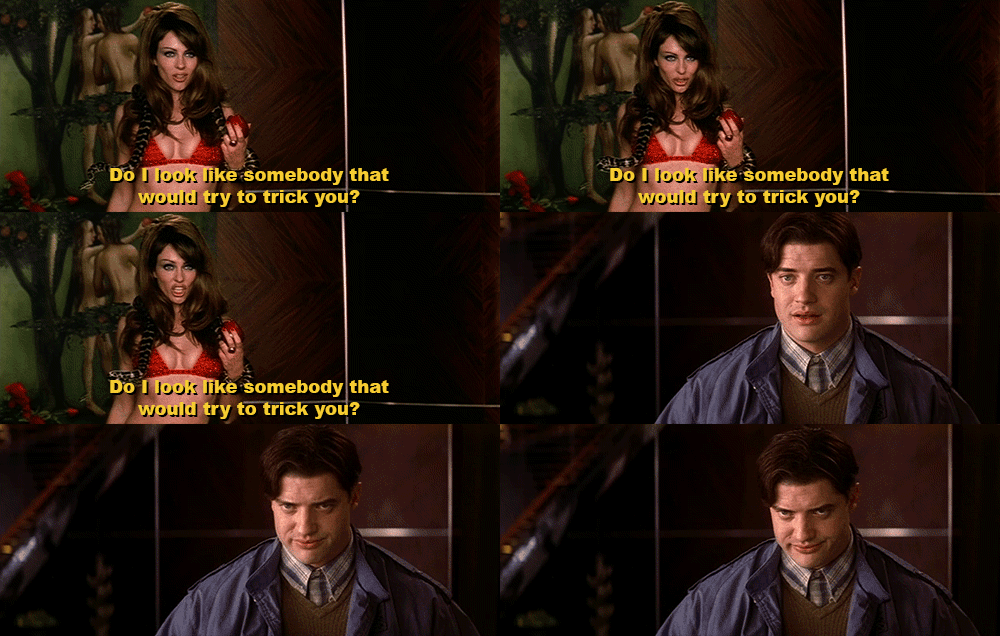
  • Elizabeth Hurley plays the Devil in the 2000 remake of Bedazzled.
Elizabeth Hurley and Brendan Frasier in Bedazzled (2000). Image source: Tumblr.