Thursday, February 18, 2016

240: Wicked movie roles

The following actors, listed on page 240 of The Billionth Monkey, have all played Satan or a similarly devilish character in major movies:
  • Al Pacino plays John Milton (Satan) in The Devil’s Advocate (1997)  [John Milton is named after the author of Paradise Lost.]
  • Robert DeNiro portrays Louis Cyphre in one of my favorite movies, Angel Heart (1987).
  • Jack Nicholson plays the devilish Daryl Van Horne in The Witches of Eastwick (1987).
  • Before he was Aragorn in Lord of the Rings, Viggo Mortensen was Lucifer in The Prophecy (1995).
  • Tim Curry played the decidedly devilish Darkness in Ridley Scott’s Legend (1985).
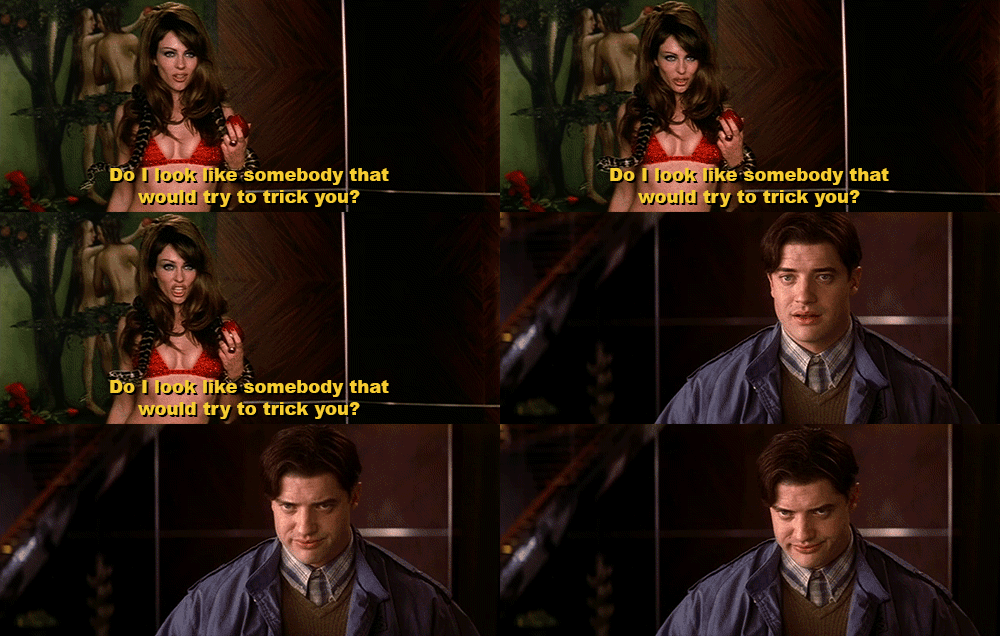
  • Elizabeth Hurley plays the Devil in the 2000 remake of Bedazzled.
Elizabeth Hurley and Brendan Frasier in Bedazzled (2000). Image source: Tumblr.

Wednesday, February 17, 2016

Page 234-240: Haikus and Easter eggs about science

On page 234 we get in haiku form the well-known Higgs boson joke captured by this meme:


Turns out the particle has been the subject of an awful lot of jokes. There was plenty of talk about the Higgs boson in 2012 (approximately when The Billionth Monkey takes place), as on July 4 of that year CERN announced that it has detected a particle consistent with predictions of how the Higgs boson would behave.

In the Tweezer post on page 239, we find a representation of the numeral 1.239841930 x 10⁻⁶, a fundamental constant in physics which is derived from the Planck constant, h, and the speed of light, c. It is known as the inverse meter-electron volt relationship as expressed in Ev units. There is no particular significant to my use of this constant: it was simply one whose digits fit my needs for this Tweezer post. Plus SCIENCE! The number repeats in the post on page 240, where we also pick up the number 1028...which, much to my chagrin, was a typo. I meant to use 1024, the number of values in a 10-bit binary word or 210. But much like the Planck constant, it didn't signify anything other than my desire to sneak in an interesting number.

Tuesday, February 16, 2016

Page 233: Creatio ex nihilo

Creatio ex nihilo is Latin for “creation out of nothing,” and occurs primarily in philosophical, metaphysical and religious discussions. It often refers to the Biblical doctrine that God created the world out of nothing by simply uttering the appropriate words, e.g. fiat lux (“let there be light”). This contrasts with Parmenides’ maxim ex nihilo nihil fit, “out of nothing, nothing is made.” Or as Rush sings, “You don't get something for nothing”:


Creatio ex nihilo can be used in other contexts, as Nicholas does in his cooking metaphor. His remark fiat lunch is a pun on fiat lux.

An early draft of the manuscript also had Nicholas saying “And when it comes to charcuterie, saltpeter is my rock.” While it isn’t used so much these days, saltpeter or potassium nitrate has been used for curing meats. In this context it’s also a pun on Matthew 16:18 (“And I say also unto thee, That thou art Peter, and upon this rock I will build my church; and the gates of hell shall not prevail against it.”). The Greek name Peter (Πέτρος, Petros) comes from the word πέτρα, petra, which means “rock.” This wordplay would have been obvious to Matthew’s readers, as the New Testament was written in Koine Greek. It’s kind of like writing a story about a wealthy boy and naming him Richie Rich. In the end, I decided to cut this line because I thought the joke was weak, and the dialogue punchier without it.

Monday, February 15, 2016

Page 232: Bill Gates—Antichrist?

From the Omen trilogy (1976–1981) to the Son of Satan comics, we read on page 232 a list of ways in which the legend of Satan (and those presumably allied with him) has become positively epic in popular culture. One of the more obscure references here is to the notion that Bill Gates is the anti-Christ, based on the observation that his name—when the letters are translated into their corresponding ASCII values—adds up to 666:
B = 66
I = 73
L = 76
L = 76

G = 71
A = 65
T = 84
E = 69
S = 83

I = 1
I = 1
I = 1
------
= 666
Check the math, it works.

Is Bill Gates the devil? Or at least Keyser Soze? Not so fast!
[Image source: here. This image appears on several blogs, but none give a photo credit.]

There are a few problems here, of course. To arrive at 666 we are forced to use not “Bill Gates” (as he is best known) but “Bill Gates III.” As opposed to “William Gates,” “William Henry Gates III,” or any other variation on his name. Also, there’s a problem with that “III” part of the solution: There is no ASCII symbol with a value of 1; that value is reserved for the SOH (start of heading) character. The numeral 1 has an ASCII value of 49, while the Roman numeral I (or capital i) has an ASCII value of 73…as we see in “BILL.” As you can see, numerology frequently proves some point through the use of elaborate contortions and tortured logic that would leave Ockham twitching.

It reminds me of one of Aleister Crowley’s lines from “Ascension Day” in The Sword of Song (1904), whereby one:
…by all sorts of monkey tricks
Adds up my name to Six Six Six.
[Does that make this a #MonkeyReference?] Crowley, of course, was guilty of such monkey tricks himself. The back cover of The Sword of Song transliterates his name as אלהיסטהר ה כרעולהי or ALHYSTHR H KR’VLHY. While not a bad transliteration, red flags rise with the use of the letter ayin for “o” and the presence of the middle initial “E”...which is actually from his first name, Edward; Aleister is the Gaelic form of his legal middle name, Alexander...and never mind that, except for this one book, he never signed himself Aleister E. Crowley. Granted words are often transliterated or translated into Hebrew multiple ways: for example, Google Translate suggests קראולי for “Crowley,” but that throws off the math. At least AC warns you in plain English that his is a monkey trick. One might even call it a cynocephalus stunt. ;)

And don’t even get me started on the practice of colel, an optional ±1 so that if the number you get isn’t to your liking, you can use one of its neighbors instead if that’s better. Gematria can—and has—been used as a tool for exegesis, meditation, or even just plain fun (as I’ve done throughout The Billionth Monkey). But it’s far from an exact science. As we see with the above example, it frequently gets seriously abused and needs to be taken with several grains of salt.

Friday, February 12, 2016

Page 230 – 231: Blond villain trope…literally!

Casting blond actors as villains is a well-known trope. The examples that Nicholas Young rattle off on page 230 of The Billionth Monkey are: the despised boy-king from Game of Thrones; the emo affluenza-teen from the Harry Potter books/movies; Baron Harkonen’s feisty nephew from Dune (portrayed by Sting in David Lynch’s film adaptation); Rutger Hauer’s fantastic villain from Bladerunner; and Leonardo DiCaprio’s villain from Django Unchained (although he’s more of a dishwater blond).
Gratuitous photo of Feyd Rautha (Sting) wearing nothing but a fancy codpiece in David Lynch’s 1984 big-screen adaptation of Frank Herbert’s sci-fi classic Dune.
The discussion of “literally” on page 231 refers to the ballyhooed August 2013 news item about Merriam-Webster and Cambridge added to their dictionaries a new definition of literally that means “not literally true.” The explanation was that the definition should reflect the fact that so many people today use the word this way (i.e., incorrectly). By this logic, “supposably” and “irregardless” will undoubtedly be added to the dictionary, and plurals should end with an ’s. And you kids get off my lawn! (figuratively)

However, as National Geographic points out, the non-literal usage of “literally” has a two hundred-year history in the English language. So arguably these dictionary definitions are simply catching up with the Oxford English Dictionary, which has listed the secondary meaning of “literally” since 1903 without any blow-ups, literally or figuratively.

Speaking of literally…the Bible is a text that many people read literally (either definition of the word may apply). The mention on page 231 of the number 144,000 refers to the last book in the Bible. Revelation makes two references to this number: In chapter 7, 12,000 members of each of the twelve tribes of Israel (12 x 12,000 = 144,000) are sealed, saved or redeemed from the tribulations visited upon the earth. Then in chapter 14, we hear of 144,000 who are sealed with the name of God upon their foreheads, and who sing a new song before the throne. Naturally, opinions differ as to whether this number is to be read literally.

Thursday, February 11, 2016

Page 229–230: Bad Science and Bad Angels

The line “Erg, I’m dyne!” on page 229 is a bad science joke dressed up in a Scottish accent. In physics, an erg is a unit of energy equal to 10-7 joules. A dyne is a unit of force equal to 10-5 Newtons. Together, “An erg is the amount of work done by a force of one dyne exerted for a distance of one centimeter.” This is quite possibly the biggest groaner in The Billionth Monkey...but in my defense I didn’t invent the joke; it’s pretty well known among science nerds.


When Nicholas Young remarks “You monkeys really are incredibly stupid” (page 230), it isn’t just an obvious #MonkeyReference. He’s using the same disparaging term for humankind that we hear from Christopher Walken (the archangel Gabriel) and Viggo Mortensen (his unlikely ally) in the movie The Prophecy (1995). In fact, at home “monkeys” is how my wife and I imagine our cats refer to us when plotting to overthrow the household. Finally, Stoop!d Monkey is the production company of Seth Green and Matthew Senreich, which is involved in the Adult Swim program Robot Chicken...which, like The Billionth Monkey, is also a cavaldade of pop culture references.

Wednesday, February 10, 2016

Page 223: Another numerological Easter egg

Destiny Jones’ Tweezer post on page 223 of The Billionth Monkey packs a pun into its numerological Easter egg:
  • 61 (from 61 likes) = אין, ain, nothingness.
  • 61 also = בטן, beten, belly.

Ain is one of the "Three Veils of Negative Existence" in the Western esoteric Tree of Life.
(Art by Frater Ash, image from Thelemapedia.)
Therefore Destiny has an empty belly and wants to eat something. Badum-tish! [See also the related blog post for page 111, "Fun with Numerology."]

Fat Bastard from Austin Powers: The Spy Who Shagged Me (1999) spawned his own meme.